
Log Market - December 2025
 |
Scott Downs General Manager Sales & Marketing PF Olsen Limited |
Market Summary
Falling log prices in China, amid weak market sentiment, resulted in AWG (At Wharf Gate) prices declining by NZD 4 in December. CFR log prices in China have continued to soften, falling by a total USD 5, and this points to additional downward pressure on AWG prices in January. The strengthening of the NZD against the USD, up 2.1% over the past month, will add to this pressure, although lower shipping costs are expected to partially offset the decline.
Log demand in China remains relatively consistent, and many New Zealand forest owners are taking extended production breaks over the summer period. This reduction in supply to China is timely, as market activity is expected to slow ahead of the Chinese New Year Spring Festival holiday period beginning on 17 February.
Domestic log prices in New Zealand remain stable, with most pricing already set for Q4. The outlook for 2026 is slightly more positive than 2025.
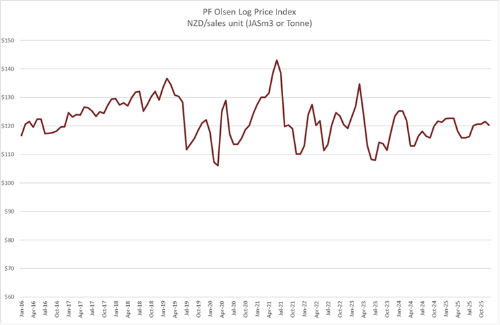
The PF Olsen Log Price Index fell by $2 to $120. This places the Index $1 above the two-year average and level with the five-year average.
Domestic Log Market
Log prices are anticipated to remain stable during Quarter 1 2026. Demand for industrial-grade timber is starting to increase as it is used to construct pallets and packaging used for exporting seasonal fruit harvests. Some mills have increased production through Quarter 4 due to low stocks levels through the supply chain.
Looking ahead to 2026, there is a growing body of evidence suggesting that domestic demand for sawn timber in New Zealand is likely to improve. While construction activity has remained subdued through 2024–25, forward-looking indicators point to a gradual recovery from 2026 as residential building stabilises and infrastructure activity lifts. Government construction pipeline forecasts show total construction activity bottoming out in 2025 and increasing from 2026, which would support higher consumption of structural and appearance-grade sawn timber.
Building consent trends are consistent with this view. Although consent volumes remain well below peak levels, recent data indicates that the decline has largely run its course, with signs of stabilisation emerging in late 2025. Historically, movements in building consents translate into changes in sawn timber demand with a lag of several months, suggesting that any sustained improvement in consents would flow through to stronger domestic timber demand during 2026.
Broader economic conditions are also becoming more supportive. Easing inflation and expectations of lower or stable interest rates into 2026 are expected to improve housing affordability and confidence, supporting both new builds and renovation activity. Industry commentary from domestic processors indicates improving enquiry levels and a more constructive outlook for early 2026, although most mills remain cautious and expect any recovery to be gradual rather than sharp.
Overall, while risks remain around export market weakness and the pace of construction recovery, the balance of indicators suggests that domestic sawn timber demand is more likely to increase than decline in 2026. Any improvement is expected to be moderate, but it would represent an important shift from the weak conditions experienced over the past two years and could help underpin more stable domestic markets for logs and sawn products.
Export Log Markets
China
CFR prices for A-grade logs for December vessel arrivals are currently in the range of USD 108–113 per JASm³, representing an average decline of around USD 5 over the past month. Despite this price weakness, daily pine log port offtake remains steady at approximately 55,000 m³, and softwood log inventories are largely unchanged, indicating that supply and consumption remain broadly balanced at current activity levels.
The Caixin China General Manufacturing PMI rebounded to 51.5 in November, signalling a return to expansion and an improvement in business sentiment. The uplift was driven by the strongest growth in foreign sales since February 2023, suggesting some stabilisation in export-oriented manufacturing, although this has yet to translate into improved demand for construction-related materials. Residential construction activity in China remains subdued, with limited signs of near-term recovery. This continues to weigh on demand for lower-grade structural logs, even as manufacturing indicators show improvement.
Chinese log buyers remain cautious, prioritising hand-to-mouth purchasing with further price pressure for log exports to China in the absence of any clear recovery in demand.
New Zealand continues to dominate China’s softwood log supply, accounting for approximately 75% of total imports, meaning changes in New Zealand harvest or export volumes have a material influence on market balance. Many New Zealand forest owners are taking longer-than-usual production breaks over the Christmas and New Year period, which will temporarily constrain supply. However, this is expected to be largely offset by seasonally slowing demand in China ahead of the Lunar New Year holiday in February, with mills typically reducing log purchases to avoid carrying elevated inventories through the holiday shutdown period.
India
The log market in Kandla continues to face headwinds from currency weakness and global trade tensions. The Indian rupee (INR) has weakened materially against the US dollar in 2025, sliding to near record lows by mid‑December as trade uncertainty and capital outflows weigh on sentiment. This marks roughly a 5–6% year‑to‑date depreciation against the dollar and makes the INR one of Asia’s weaker performing currencies this year. Persistent pressure reflects broader trade dynamics and uncertainty over the US‑India trade outlook, although recent Reserve Bank of India (RBI) interventions have helped mitigate extreme volatility.
Increased US tariffs on Indian exports have contributed to ongoing export market challenges. Total exports to the US are approximately 17% of India’s overall export mix, and those tariffs have negatively impacted key goods sectors, contributing to slower external demand and weakening currency pressures.
Kandla is expecting around 12 bulk vessels of pine logs to arrive during December. Prices for sawn timber in the region have softened, with current green sawn timber prices around INR 521 per CFT for material derived from both New Zealand and South American logs, as the usual price premium for radiata pine has disappeared.
Ocean Freight
Shipping costs typically ease in December and January as seasonal demand softens ahead of the Chinese New Year, and a similar pattern is evident this year. Although the Baltic Dry Index (BDI) has recently increased, this rise has been driven primarily by stronger rates for Capesize vessels, which carry bulk commodities such as iron ore and coal, rather than the smaller vessel segments that are most relevant to log shipping.
The BDI is a composite index comprising three sub‑indices: Capesize (40%), Panamax (30%) and Supramax (30%), and reflects average daily USD hire rates across key ocean freight routes. Most New Zealand log exports are carried on Handysize vessels, which are not directly included in the BDI calculation, though broader freight cost trends can still exert indirect influence on this segment.
Recent global freight market drivers include:
-Softening seasonal demand in the Pacific as charter activity slows ahead of holiday periods in both China and Southeast Asia.
-Lower bunker fuel costs in late 2025, which have helped reduce voyage costs across many vessel classes.
-Port congestion improvements in some major Asian and Middle Eastern ports, which has reduced waiting times and demurrage risk for bulk and break‑bulk carriers.
-Regional trade imbalances, particularly lower Chinese iron ore and coal imports, which have boosted Capesize utilisation but have limited flow‑on benefits for smaller vessels.
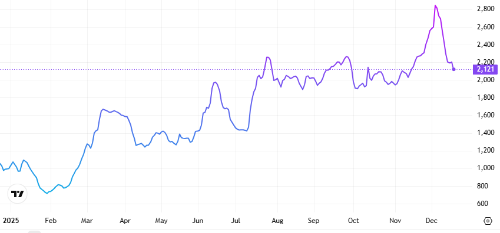
Baltic Dry Index (BDI)
Source: TradingEconomics.com
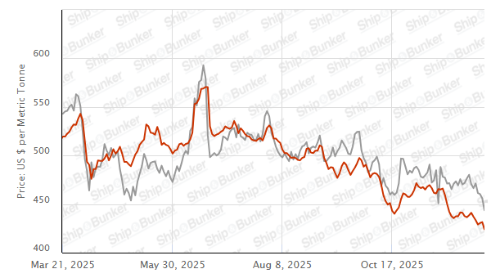
Singapore Bunker Price (VLSO) (red line) versus Brent Oil Price (grey line)
Source: Ship & Bunker
Exchange Rates
The NZD has appreciated by approximately 2% against the USD over the past month, although it has softened by 0.8% in the past week. Movements in the NZD–USD exchange rate will remain an important consideration in setting AWG prices for January. Meanwhile, the CNY has continued to strengthen against the USD, rising 0.9% over the last month, which may provide Chinese log buyers with slightly increased purchasing power.
PF Olsen Log Price Index - December 2025
The PF Olsen Log Price Index fell by $2 to $120. This places the Index $1 above the two-year average and level with the five-year average.
Indicative Current Log Prices – December 2025
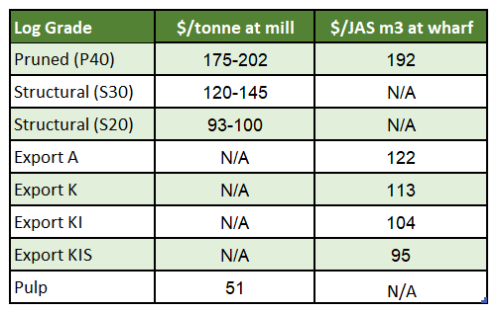
These prices should be used as a guide only and specific advice sought for individual forests.