
Log Market - August 2026
 |
Scott Downs Head of Sales & Key Clients Stand Forestry Limited |
Market Summary
The New Zealand domestic market for sawn timber continues to strengthen. Sawmillers report the best winter demand for several years, with increasing forward orders and improving residential construction activity providing confidence heading into spring. An average 5% increase in sawn timber prices is planned for September, while most processors will remove the existing fuel surcharge.
At Wharf Gate (AWG) prices for export logs were stable in August with no change from July pricing. However, ocean freight costs remain elevated, and the NZD has strengthened against the USD during August, both of which will place downward pressure on AWG returns. Offsetting these are modest increases in log prices in China, supported by stable daily demand and relatively low softwood log inventories.
The Indian market remains subdued during the monsoon period. Weak sawn timber demand, unsold log inventories and port congestion are placing pressure on sawmill margins and limiting buyers’ appetite for additional logs. The weakening INR against the USD is adding further pressure to the landed cost of imported logs, with a more meaningful improvement in demand not expected until after the monsoon and Diwali periods.
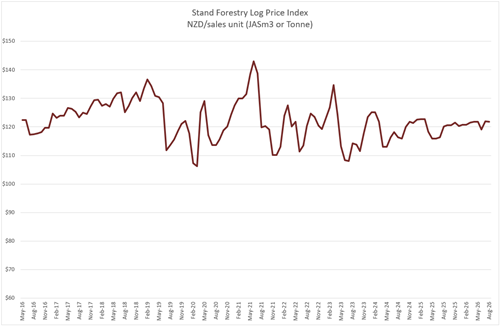
The Stand Forestry Log Price Index remains at $122 which is $2 above the two-year average and $3 above the five-year average.
Domestic Log Market
Most domestic log processors will remove the 2% fuel surcharge on domestic sawn timber in September, coinciding with an average 5% increase in sawn timber prices. A small number of suppliers are maintaining the fuel surcharge for now, although competitive pressure may see these suppliers follow the wider market relatively quickly.
Sawmill managers report that the domestic sawn timber market continues to improve as building activity gradually increases. Winter demand has been stronger than experienced for several years, with forward orders providing increased confidence heading into spring. Without the disruption and additional costs associated with elevated fuel prices, market conditions would likely have been stronger again.
The improving sentiment is supported by the residential construction pipeline. New dwelling consents have increased significantly compared with last year, led particularly by multi-unit housing. While a building consent does not immediately translate into timber consumption, the increasing pipeline of consented projects provides a positive indicator for residential construction activity over the coming months.
Infrastructure activity is also providing increasing support to the broader construction sector. The latest National Infrastructure Pipeline shows $71.2 billion of projects currently under construction, with approximately $17.5 billion of additional projects expected to enter construction over the next 12 months. Civil and infrastructure contractors currently have stronger forward workloads than the residential and commercial sectors.
Sawmillers are therefore increasingly optimistic heading into the traditional spring and summer increase in timber demand. However, this optimism remains tempered by uncertainty around fuel and other input costs, particularly given ongoing geopolitical tensions in the Middle East.
China
CFR prices for A-grade logs from New Zealand have crept up a few dollars in the past month and are currently in the range USD 125-130 per JASm³. The strengthening CNY against the USD has increased the purchasing power of the Chinese log buyers.
Softwood log inventories in China have remained stable with slight drops albeit with regional variations. Daily log offtake remains steady at approximately 55,000 m³ per day.
China’s RatingDog China General Manufacturing PMI (formerly the Caixin Manufacturing PMI) eased to 50.9 in July, down from 51.7 in June. While this represents a four-month low, the index remained above the 50-point expansion threshold for the eighth consecutive month, indicating continued, albeit slower, growth in manufacturing activity. So, there is an interesting divergence in July: the private-sector PMI was 50.9, indicating modest expansion, while the official NBS PMI was 49.2, indicating contraction.
China’s new 2026–2030 five-year forestry plan aims to increase forest coverage to 25.8% and total forest stock volume to 22.4 billion m³ by 2030, while expanding the value of the forestry and grassland sector to RMB 14 trillion.
While much of China’s forest estate is unavailable for intensive commercial harvesting, increased production from plantations and managed forests, together with improvements in harvesting, transport and processing infrastructure, could progressively increase the volume of domestically produced timber available to Chinese processors.
China will remain a major timber importer, but even a relatively modest increase in commercially available domestic wood could reduce its requirement for imported softwood logs.
This is particularly relevant for New Zealand, given China’s dominant share of our export log market. Chinese-grown logs have traditionally struggled to compete with New Zealand radiata pine in higher-value grades due to differences in silviculture, log quality and consistency. Increased domestic production is therefore more likely to compete with lower-grade industrial logs, where price is a greater consideration and quality differentiation is less important. The impact is unlikely to be immediate, as additional forest resources take time to translate into commercially harvested volume, but over the longer term greater Chinese domestic supply could reduce marginal demand for imported logs.
This reinforces the importance of developing alternative markets such as India and Southeast Asia while maintaining New Zealand’s competitive advantage in higher quality radiata grades.
India
The Kandla market remains subdued due to the seasonal reduction in demand during the monsoon period. Green pine sawn timber prices have fallen to around INR 601–621 per CFT, while CFR prices for New Zealand A-grade logs are around USD 160 per JASm³. The current relationship between log and sawn timber prices continues to place pressure on sawmill margins.
Approximately eight vessels carrying around 280,000 m³ of pine logs have berthed at Kandla during August. Port congestion remains an issue, with vessels using priority berthing windows experiencing delays of around 4–5 days, while normal berthing delays are approximately 7–8 days.
There are also unsold pine logs being held in bonded yards at Kandla, with some volumes being offered at discounted prices. With monsoon conditions continuing to suppress demand, buyers have little incentive to increase inventory at present. Market participants expect pine log demand to begin improving after the monsoon and Diwali periods, with a more meaningful recovery anticipated from around mid-November.
The Tuticorin market continues to operate quite differently from Kandla. The port recently received a part-bulk parcel of approximately 11,000 JASm³ of Australian pine logs, carried alongside agricultural products in other vessel holds. Tuticorin also continues to receive containerized pine logs from South Africa, the United States, Australia and New Zealand. Import prices range from approximately USD 145 per metric tonne to USD 166 per JASm³ for A-grade logs, depending on origin and shipping arrangements.
Green pine sawn timber sold by importers using Tuticorin Port is currently achieving around INR 700–750 per CFT, maintaining a significant premium over the Gandhidham market.
India's Manufacturing Purchasing Managers' Index (PMI) declined to 52.9 in August from 53.5 in July, indicating that manufacturing activity continues to expand, but at a slower rate. The August reading represents the weakest rate of expansion in several years and is consistent with the softer demand conditions currently being experienced across parts of the economy.
Ocean Freight
Shipping costs remain high with a vessel loading at two ports on the North Island then sailing to China costing high USD 40’s per JASm3. The Baltic Dry Index remains relatively high as shown below.
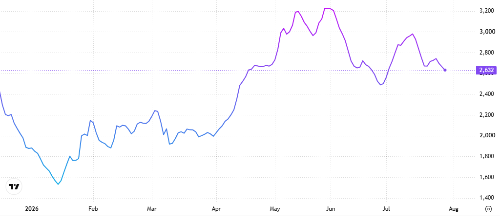
Baltic Dry Index (BDI)
Source: TradingEconomics.com
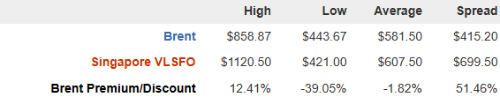
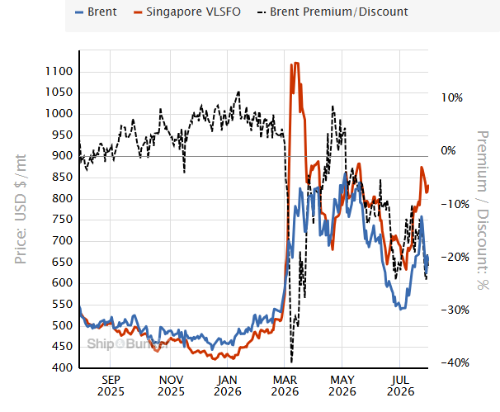
Singapore Bunker Price and Brent Crude Oil Price
Source: ShipandBunker.com
Exchange Rates
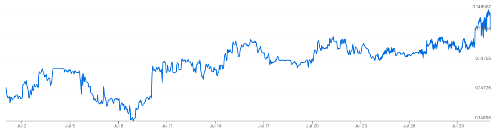
The NZD has strengthened against the USD by 3% over August. This will have a negative impact on AWG price calculations for New Zealand log suppliers. Fortunately, over the same time, the CNY has increased by 6.4% against the USD increasing the buying ability of Chinese log buyers. Unfortunately, the INR has weakened by 8.3% against the USD, reducing their purchasing ability.
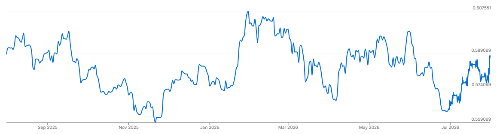
NZD:USD
CNY:USD
PF Olsen Log Price Index - August 2026
The Stand Forestry Log Price Index remains at $122 which is $2 above the two-year average and $3 above the five-year average.
Indicative Current Log Prices – August 2026
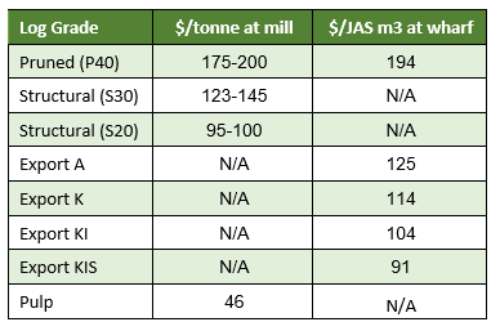
Please note these are indicative AWG prices at North Island ports and that South Island prices are commonly lower due to higher port and shipping costs. Actual prices will vary according to regional supply/demand balances, varying cost structures and grade variation.
These prices should be used as a guide only and specific advice sought for individual forests.